
PEAKLIFE
10-Feb-2026
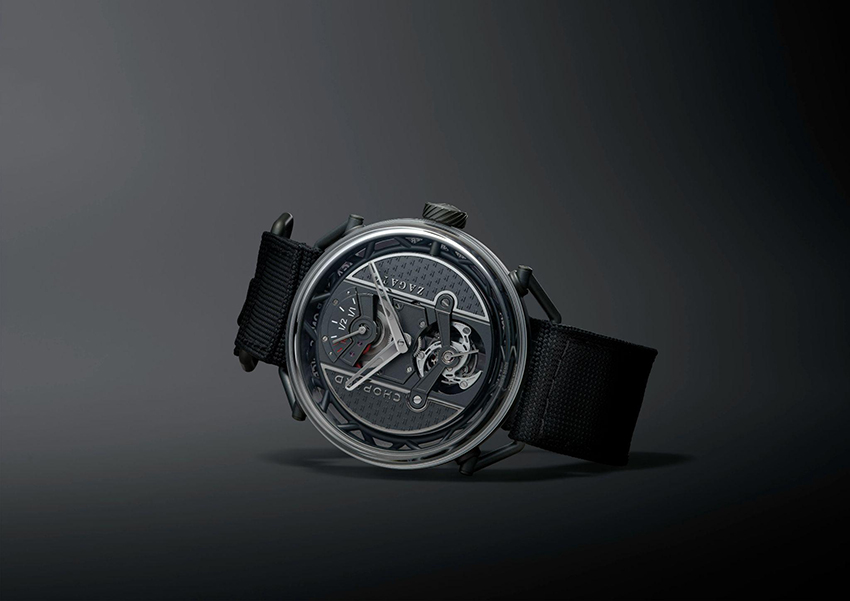
Chopard with the new Zagato Lab One Concept timepiece showcases its watchmaking expertise and sense of innovation with a superlight concept watch developed in collaboration with the Italian automotive atelier.
The new Zagato Lab One Concept timepiece in ceramicised titanium unites Chopard’s passion for automobiles with the spirit of innovation and craftsmanship cultivated by its Manufacture in Fleurier for 30 years.
Weighing in at just 43.20 grams, including the strap, it is the lightest watch ever created by Chopard in titanium. With its Tubular construction, this third collaboration between the Maison and the Zagato Design Studio draws cues from typical concept car characteristics.
A Creative Collision of Two Design Cultures
At its core lies a bold translation of tubular chassis architecture, a hallmark of Zagato’s automotive engineering. In racing cars, tubular frameworks optimise rigidity while reducing weight. Here, Chopard transposes the same principle to watchmaking: the movement is suspended within a framework of tubes, distributing mechanical stress and improving shock resistance—an unprecedented construction for the Maison.
Dial & Display: A Dashboard for the Wrist
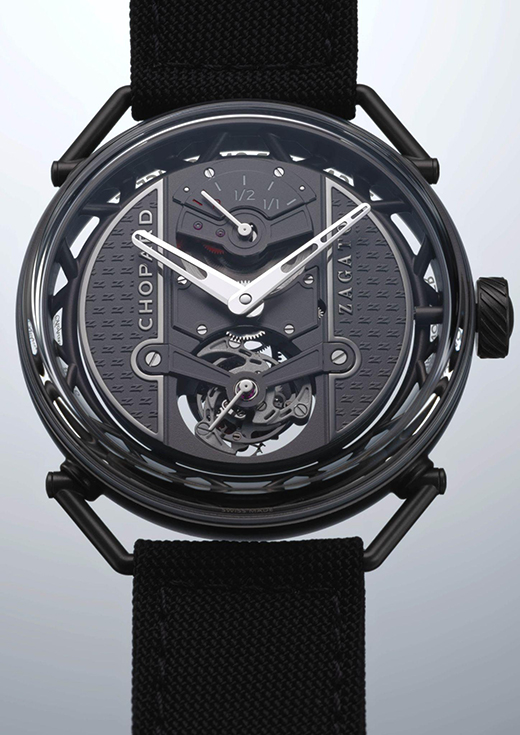
The dial is not a separate element—it is the movement. The mainplate serves as the dial, adorned with Zagato’s recurring “Z” motif, its chamfers highlighted by rhodium-plated finishes. The Chopard and Zagato logos appear in polished relief, understated yet assertive.
A domed ‘glass box’ sapphire crystal, fitted flush with the case band, enhances legibility while reinforcing the instrument-like character of the watch. The caseback mirrors this construction, offering an unobstructed view of the movement and creating a visual symmetry rarely seen in experimental timepieces.
Replacing traditional lugs, tubular open loops allow the watch to pivot up to 45 degrees on each side, ensuring ergonomic comfort despite its architectural form. The crown—modeled after an automotive differential gear and engraved with a steering wheel motif—cements the racing narrative.
Ceramicised Titanium: Extreme Performance, Minimal Weight
The 42 mm case, movement bridges, and mainplate are all crafted from ceramicised titanium, produced through an electro-plasma oxidation process. The result is a material with a hardness of 1,000 Vickers, comparable to ceramic, yet significantly lighter and more impact-resistant.
Developed for aerospace and automotive applications, ceramicised titanium offers exceptional shock and scratch resistance, along with an anthracite-grey hue that does not fade over time. For a watch engineered for extreme conditions, the choice of material feels not just appropriate but inevitable.
L.U.C Calibre 04.04-L: A Mechanical Engine
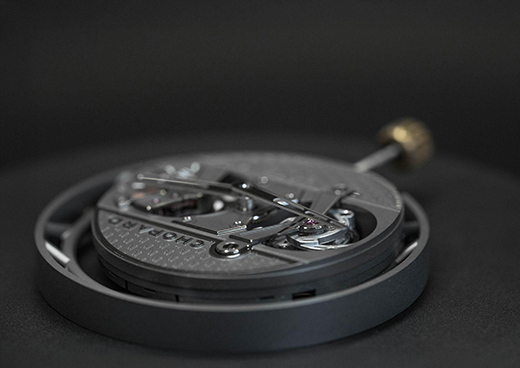
Powering the Zagato Lab One Concept is the hand-wound L.U.C Calibre 04.04-L, an evolution of Chopard’s Engine One Tourbillon calibre first introduced in 2010. Like the case, its bridges and baseplate are crafted entirely from ceramicised titanium, reinforcing the watch’s obsession with material coherence and lightness.
The movement retains the distinctive fuel-gauge-style power reserve, strengthening the dashboard analogy, while adopting a round architecture that distinguishes it from earlier Engine One iterations.
At its heart beats a 60-second tourbillon, paired with a Variner® balance and a hairspring with a Phillips terminal curve, housed in an aluminum carriage to further reduce weight. A shock-absorbing system inspired by automotive silent blocks dampens vibrations, while four lever arms integrated into the caseband ensure mechanical stability.
Chronometer-certified by the COSC, the calibre delivers a 60-hour power reserve and precision to match its visual drama.
Final Word
The Chopard Zagato Lab One Concept is not designed to be universally appealing—and that is precisely its point. It is a watch for collectors who value experimentation over tradition, engineering over ornament, and future-thinking over familiarity.
Like a concept car, it exists to challenge assumptions, push boundaries, and demonstrate what is possible when form follows performance without compromise.